
How to Get More Website Visibility in Google AI Mode
 By YW Digital Edge
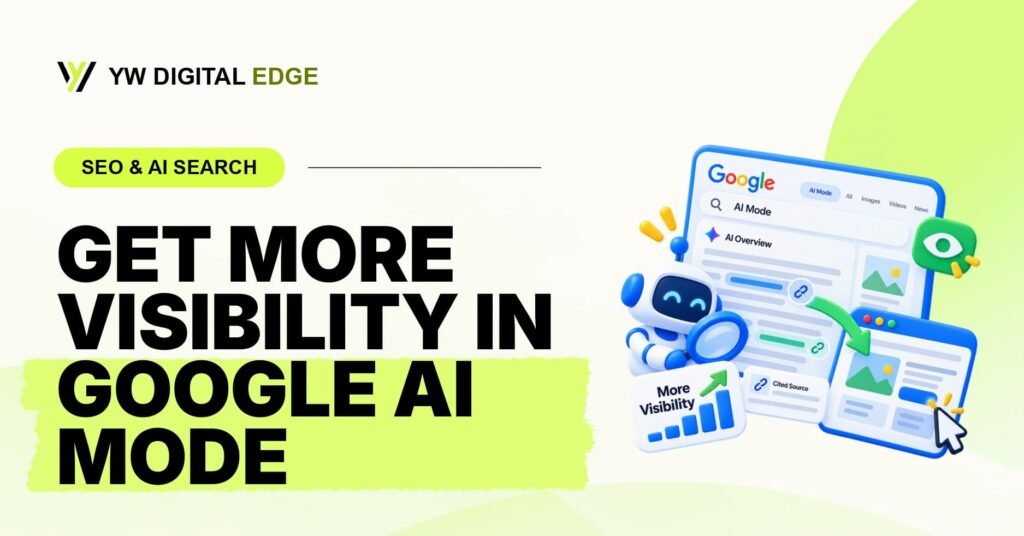
Google AI Mode is becoming more generous with links to the web.
In October 2026, Google announced another set of changes designed to make sources easier to discover inside AI-generated search results. Inline links are appearing more frequently, some are being placed higher in responses, and Google is testing more prominent links when a particular website is especially useful for completing a task or finding specific information.
For businesses and publishers, this makes an important part of AI search clearer: appearing in an AI-generated answer and earning a visit from that answer are two different things. Google may use information from across the web to build a response, while the user decides whether the answer is enough or whether one of the linked sources is worth exploring.
That changes what good search content needs to accomplish. A page needs to be understandable and useful to Google’s systems, but it also needs to offer enough additional value that someone has a reason to click through.
More Links in AI Mode Create More Opportunities to Be Discovered
AI Mode can answer questions that previously required several searches.
Someone researching a new CRM, for example, might ask Google to compare platforms for a 20-person sales team, consider integrations with existing software, explain pricing differences and recommend what to evaluate before making a decision.
Instead of returning only a list of traditional search results, AI Mode can develop a response using information retrieved from multiple sources. Google says AI Mode and AI Overviews can use a technique called query fan-out, where the system issues multiple related searches across subtopics and data sources.
This allows Google to find supporting pages that address different parts of a complex question. Links are an important part of that experience.
Google has been increasing the number of inline links inside AI responses and improving how those links are presented. Its October 2026 update also introduced more frequent placement of inline links higher in responses.
For certain queries, Google is testing an even more prominent treatment. When one or two websites are particularly relevant for completing a task or accessing specific information, those destinations may appear near the top of the AI response with additional context explaining why they are useful.
Google is also expanding visual carousels for timely articles and continuing to highlight Preferred Sources. For website owners, this creates more potential entry points.
Your page does not necessarily need to be the single definitive answer to an entire query. It may be useful because it provides the best explanation, comparison, original evidence or next step for one part of what the user wants to know.
Start With the Same SEO Foundations That Help Google Search
AI Mode has introduced new terminology around search optimisation, but Google has been unusually clear about the technical requirements. A page that wants to appear as a supporting link in AI Mode needs to be indexed and eligible to appear in Google Search with a snippet.
Google does not require a special AI schema or a separate AI-formatted version of the page. Its latest guidance for generative AI Search continues to emphasise familiar SEO work, including crawlability, indexation, internal linking, useful content and page experience.
Before looking for specialised AI optimisation tactics, check that:
- Important pages are accessible to Googlebot.
- Internal links make those pages easy to discover.
- Canonicalisation and indexation are handled correctly.
- Important information is available in accessible text.
- Relevant images and videos support the page where visual information adds value.
- Structured data accurately represents the content users can see.
These fundamentals sound ordinary because they are ordinary. They are also the infrastructure Google relies on when retrieving information for its generative Search experiences.
A useful article buried several clicks deep with weak internal linking is harder to discover than the same article properly integrated into the website. A technically polished page with thin, generic content has the opposite problem: Google can access it easily, but the page contributes very little.
Strong AI Mode visibility requires both sides to work together. This is also why the broader principles covered in SEO for AI Search still begin with conventional search foundations.
Give Google Information Worth Retrieving
Once a page can be discovered and indexed, content quality becomes the larger question. Google’s current guidance for generative AI Search places particular emphasis on valuable, unique and non-commodity content.
Commodity content is easy to reproduce.
Consider a renovation company publishing an article titled 5 Tips for Planning a Home Renovation. The advice might simply tell readers to:
- set a budget;
- choose a contractor;
- plan the timeline;
- select materials;
- prepare for disruption.
The information may be correct, but thousands of websites could produce essentially the same article.
A more useful resource could explain what actually causes renovation budgets to change after work begins, which decisions homeowners should finalise before requesting quotations, where allowances commonly create confusion and how changes during construction affect the final cost.
The company could also include photographs from real projects, examples of scope changes and explanations based on experience. That gives the page something distinctive.
The same principle applies across different industries:
- A software company can publish real implementation findings.
- An ecommerce business can provide detailed product comparisons, measurements and original photographs.
- A manufacturer can explain technical decisions using actual production experience.
- A service business can show what happens during a real project and which problems commonly occur.
- A consultant can publish original analysis, processes or anonymised patterns observed across client work.
Generative AI has made generic explanations extremely easy to produce. That increases the value of information grounded in real expertise, evidence and experience.
Google’s own generative AI Search guidance encourages website owners to contribute perspectives and information that go beyond material that could easily be reproduced by another website or generated from existing information.
When reviewing a page, ask:
What does someone learn here that would be difficult to get from a generic summary?
That answer may have more influence on the long-term value of the page than adding another 500 words.
Cover a Topic Properly Without Creating a Page for Every Question
Query fan-out has also created a temptation to produce pages for every possible question Google might generate. That can quickly lead to a weak content library.
Imagine an ecommerce business selling office chairs. Its potential customers may search:
- What chair is best for working eight hours?
- Is lumbar support important in an office chair?
- Mesh or fabric office chair?
- What chair is best for a small home office?
- How high should an office chair be?
- Which chair features matter for tall users?
Some of those questions may justify separate pages if the search intent is genuinely different. Others belong naturally within a larger buying guide.
A strong guide to choosing an office chair could explain working duration, posture, lumbar support, materials, adjustability, body size and workspace limitations in one coherent resource. The reader gets a more complete answer, while Google gets a page containing meaningful relationships between those concepts.
Google’s current guidance specifically warns against producing large numbers of pages simply to target every possible query variation or fan-out query. Good topic coverage comes from understanding what a reader needs to make a decision and developing those ideas properly.
It does not require turning every related question into another URL. This also matters at the section level.
Headings should help people navigate the article. A page does not become more suitable for AI Search because every paragraph has its own H2 or because the same idea is rewritten under several question-based headings.
A clear, well-developed section can cover several closely related concepts naturally.
Make Your Page More Valuable Than the AI Summary
Getting information into an AI-generated answer creates visibility. Earning the click requires something else.
Suppose someone is researching which running shoes are suitable for long-distance running. AI Mode may be able to explain that important considerations include cushioning, stability, weight, fit, running surface and training distance.
A webpage that provides only the same basic explanation gives the user little reason to continue. A specialist retailer or running website can go further with:
- original product photographs;
- detailed measurements and specifications;
- comparisons between different models;
- fit and sizing information;
- first-hand testing or experience;
- customer reviews;
- current availability;
- delivery and return information.
The AI response helps with the initial research. The source gives the reader the detail needed to evaluate the options properly or make a purchase.
The same principle works across other types of websites. A software comparison can include screenshots, implementation experience and detailed feature testing. A travel guide can provide original photographs, maps and first-hand observations. A research report can give readers access to underlying data and methodology.
Tools can be especially valuable because the interaction cannot be reproduced completely inside a summary. Calculators, configurators, templates, downloadable resources and interactive comparisons can turn informational visibility into a useful website experience.
As AI answers become more comprehensive, websites that mainly summarise widely available information may find more of that basic explanation happening directly inside search. Original evidence, first-hand experience, detailed data, useful tools and the ability to complete the next step give the source a purpose beyond the AI summary.
Build a Website Google Can Understand Beyond One Article
AI Mode visibility should also be considered across the wider website, not page by page.
Imagine an ecommerce business selling coffee machines. Instead of publishing one general buying guide, the website could have useful resources covering:
- how to choose a coffee machine;
- espresso machines vs capsule machines;
- coffee machine size and capacity;
- cleaning and maintenance;
- choosing a machine for home or office use;
- comparisons between different models;
- relevant product categories.
Each page has its own purpose, but together they give Google more context about the topics the website covers.
Internal links help establish these relationships. A general buying guide can link to a detailed comparison, while a comparison can lead to relevant product categories or individual products. A maintenance guide can also connect users to compatible accessories or replacement parts.
This gives visitors a natural path through the website and helps search systems discover how related information and products connect.
The wider business should also be easy to understand. Product information, categories, company details and contact information should remain consistent across the site, while structured data should accurately reflect what visitors can see on each page.
The result is a website where individual pages answer specific questions while contributing to a clearer overall topic structure.
Brand Recognition Can Influence What People Choose to Visit
Google’s Preferred Sources feature adds another dimension to AI search visibility. Preferred Sources allows users to select websites they value and want to see more prominently in Google.
In May 2026, Google expanded Preferred Sources into AI Overviews and AI Mode. Content from sources a user has selected can be highlighted within these experiences.
Google later introduced an embeddable Preferred Sources button that publishers can place on their own websites, giving readers a direct way to select that site as one of their preferred sources. By October 2026, Google said the number of people using Preferred Sources had grown more than sevenfold since the beginning of the year.
This is particularly relevant for publishers, specialist websites and brands that regularly produce useful information.
SEO has traditionally focused heavily on matching pages with searches. Preferred Sources introduces a more explicit relationship between the user and the source itself.
A person may eventually recognise a website because they have read several useful articles from it, subscribed to its newsletter, followed its research or encountered the brand repeatedly while researching a subject. When that happens, the website is competing on more than the relevance of one page. It has developed source preference.
This connects with a broader distinction in AI search between being mentioned and being cited. A brand can be recognised within an AI answer without its own website receiving the source link, while another website may earn the citation.
We explore that distinction in Brand Mentions vs Citations in AI Search. Both forms of visibility matter, but they tell you different things about how your brand is appearing.
Measure What Happens After You Gain Visibility
AI Mode introduces another set of search experiences to monitor, but traditional SEO metrics still matter. Rankings can show whether pages compete in conventional search, Search Console can show impressions and clicks, and analytics can show what visitors do after they arrive.
Google has also introduced dedicated Generative AI performance reporting in Search Console, giving website owners more visibility into how their content performs across generative Search experiences.
When reviewing AI search performance, it is useful to look at several layers:
| Layer | What to Look For |
|---|---|
| Visibility | Does the site appear across relevant AI search topics? |
| Citation | Which pages are being used as sources? |
| Link | Where is the website surfaced as a destination? |
| Click | Are users visiting from AI-powered Search? |
| Conversion | What do those visitors do afterwards? |
Then look for patterns at the topic and page level:
- Which topics consistently generate AI visibility?
- Which pages are being surfaced?
- Are users reaching the website from generative Search?
- Which landing pages receive those visits?
- Do those visitors continue reading, view products, submit enquiries, subscribe or purchase?
If a page is appearing but attracting little traffic, examine what the user would gain by clicking. If traffic arrives but produces little engagement, the landing page may not deliver what the search experience led the user to expect.
If a topic generates both traditional search traffic and generative AI visibility, that may be a useful area to strengthen with deeper resources. The purpose of measurement is to decide what to improve next.
An increase in AI visibility can be encouraging, but visibility becomes more valuable when it contributes to discovery, engagement and eventually a business outcome.
Improving visibility in Google AI Mode starts with the same strong SEO foundations that support traditional search, combined with content that gives Google useful information to retrieve.
Create pages with original expertise, evidence and practical value, connect related content clearly across your website, and give users a reason to visit beyond what the AI-generated answer already provides.