
How Small Businesses Can Use AI for Marketing
 By YW Digital Edge
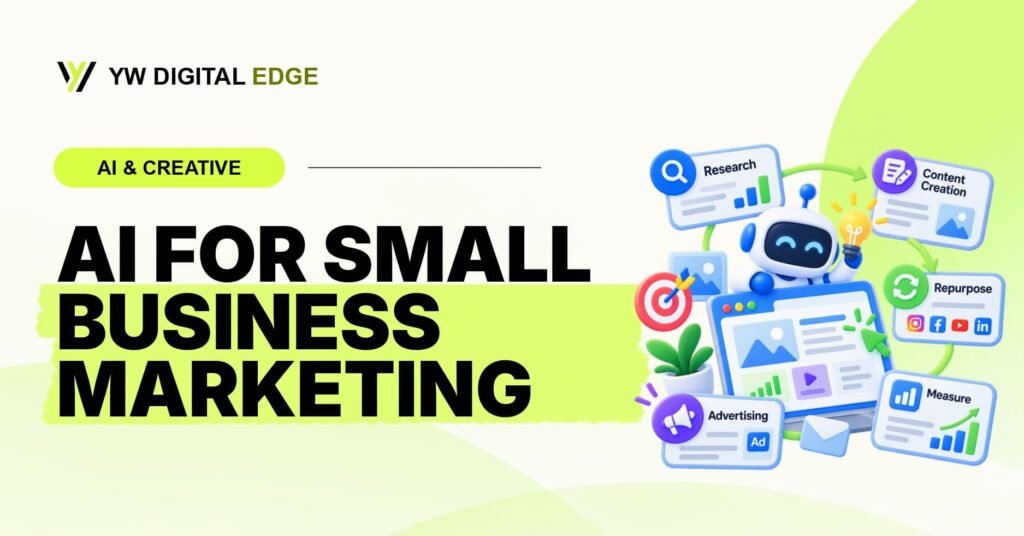
Small businesses often have more marketing work than time.
A single person may be responsible for planning social media, updating the website, writing emails, preparing ads, researching competitors, creating visuals and reviewing campaign performance.
AI can reduce some of that workload.
The most useful role for AI in small business marketing is to help people research faster, develop ideas, create first drafts, repurpose existing material and analyse information.
It still needs direction.
Give AI a vague instruction such as write an Instagram post for my business, and the result will usually sound generic. Give it information about your audience, product, objective, tone and offer, and it has much more useful material to work with.
A practical AI marketing workflow looks like this:
Research → Create → Repurpose → Review → Measure
The business provides the context and makes the decisions. AI helps move the work through the process faster.
Where Can Small Businesses Use AI in Marketing?
AI can support much more than writing captions.
Think about a small renovation company preparing its marketing for the next month.
The team needs to decide which services to promote, understand what homeowners are asking about, update several website pages, prepare social posts, create a Google Ads campaign and turn completed projects into marketing content.
AI can participate at several points in that process.
Research and marketing ideas
Before creating anything, AI can help organise information.
A business could give an AI assistant customer reviews, sales notes, enquiry questions or a list of services and ask it to identify recurring themes.
For example:
Review these 30 customer enquiries. Group the questions into common themes and identify which topics could become useful website or social media content.
Instead of manually reading every enquiry and creating categories from scratch, the business gets a starting point that can then be reviewed.
The same approach can support:
- customer question analysis;
- content brainstorming;
- competitor research;
- audience pain-point discovery;
- review analysis;
- campaign planning;
- keyword and topic exploration.
This can be particularly useful when a business already has information but has never organised it into a marketing strategy.
A furniture retailer, for example, may discover that customers repeatedly ask about room size, material care, delivery and colour matching.
Those questions can become product-page improvements, buying guides, short videos, social posts and advertising angles.
AI has not created the marketing opportunity.
It has helped the business identify a pattern in information it already had.
Website, SEO and content creation
Content is one of the most obvious uses of generative AI, but asking it to produce complete articles from a title is usually a weak workflow.
AI becomes more useful when it works with business knowledge.
Suppose an air-conditioning company wants to publish a guide about choosing the right system for an apartment.
The company already knows which questions customers ask, which mistakes are common, what affects installation and what technicians usually check before recommending a system.
That information should shape the article.
AI can then help:
- organise the information;
- build an outline;
- identify missing questions;
- draft sections;
- simplify technical explanations;
- create title alternatives;
- prepare meta descriptions;
- turn technical notes into customer-friendly language.
The business still needs to verify technical claims, add first-hand expertise and make sure the final content accurately represents its services.
This becomes even more important for SEO and AI search.
Search engines and AI systems have access to enormous amounts of generic information. Repeating the same basic explanation found across hundreds of websites gives a page little differentiation.
First-hand experience, original examples, useful data, expert explanations and clear business knowledge can make the content more valuable.
These same foundations support a broader approach to SEO for AI Search, where content needs to be discoverable, understandable and useful enough to surface across traditional and AI-powered search.
AI can help produce the content.
The business still needs to provide the substance.
Use One Good Idea Across Multiple Marketing Channels
One of the strongest uses of AI for a small marketing team is repurposing.
Businesses often create something once and then move on.
A useful article gets published on the website but never becomes a social post. A good customer question gets answered in an email but never becomes a FAQ. A product demonstration gets recorded but never becomes short-form content.
AI can help turn one useful source into several formats.
Imagine a skincare company publishes a detailed guide explaining how to choose a cleanser for different skin types.
That source could become:
Website article
The complete explanation.
Instagram carousel
Five common mistakes when choosing a cleanser.
Short video script
A 30-second explanation of one misconception.
Email
A short educational message linking to the full guide.
Product-page FAQ
Answers to common questions extracted from the article.
Ad concept
A problem-led creative angle based on one of the customer concerns.
The important part is that these assets come from the same underlying knowledge.
This keeps the marketing more consistent and reduces the need to generate completely new ideas for every channel.
The workflow can also work in reverse.
A business may have:
- recorded webinars;
- sales presentations;
- product demonstrations;
- customer support conversations;
- internal guides;
- interview transcripts;
- case studies.
AI can help identify useful ideas inside those materials and turn them into new marketing assets.
This is much more efficient than repeatedly asking:
What should we post today?
A better question is:
What useful information do we already have, and how many ways can we use it?
That shift can make AI particularly valuable for small businesses with limited content resources.
AI Can Help With Advertising and Creative Work Too
AI marketing is broader than written content.
Advertising platforms already use machine learning extensively for bidding, targeting, creative combinations and campaign optimisation. Businesses can also use generative AI before and around those campaigns.
Suppose an ecommerce company is preparing a Google Ads campaign for a new office chair.
The team could give AI the product specifications, customer reviews, target audience and existing landing-page copy.
AI could help identify different messaging angles:
Comfort
Designed for people who spend long hours at a desk.
Space
Suitable for compact home offices.
Design
A chair that fits a more considered interior.
Functionality
Adjustable features for different working positions.
These are starting points.
The marketer can decide which angles are supported by the actual product and worth testing.
AI can then help develop headline variations, descriptions, landing-page ideas and supporting creative concepts around those approved angles.
The same principle applies to visual content.
Generative AI can assist with:
- campaign concepts;
- social media graphics;
- image variations;
- storyboards;
- product backgrounds;
- presentation visuals;
- short video concepts;
- voiceovers;
- video scripts.
This can make creative production more accessible to smaller businesses, especially when they need multiple variations for different channels.
But visual quality is only part of the job.
A polished AI image can still communicate the wrong product details. A generated video can look impressive while making a claim the business cannot support. AI-generated people, environments or product representations can also create misleading impressions if customers assume they are real.
Marketing teams should review AI-generated creative with the same questions they would ask about any other campaign asset:
Is it accurate?
Does it represent the product or service correctly?
Does it fit the brand?
Would a customer misunderstand what is being shown or promised?
AI makes producing variations easier.
Human review determines which variations are suitable to publish.
Give AI Better Business Context
The quality of AI output depends heavily on the information it receives.
Compare these two prompts.
Write a Facebook post about our sofa.
Now compare it with:
Write a Facebook post for a furniture retailer promoting a compact two-seater sofa designed for apartments. The audience is young homeowners furnishing smaller living rooms. Focus on space efficiency and comfort. Keep the tone simple and contemporary. Avoid exaggerated claims. Give me three different creative angles before writing the final post.
The second prompt gives AI a much clearer job.
A useful framework is:
Task + Context + Requirements + Output
Task
Explain exactly what you need.
Create three campaign concepts.
Context
Give the AI the information required to make useful decisions.
We sell ergonomic office furniture to small businesses. The campaign targets companies setting up new offices for teams of 10–30 employees.
Requirements
Set the important boundaries.
Focus on comfort, practical office planning and professional appearance. Avoid discounts and exaggerated productivity claims.
Output
Define what you want back.
For each concept, provide a headline, key message and one visual direction.
This structure works across many marketing tasks.
It can be used for articles, emails, social content, research, advertising, customer analysis and creative planning.
Businesses that are completely new to this process can start with the broader principles in our guide to AI for Beginners.
The goal is to move beyond treating AI like a search box.
Give it enough context to work with, then use your own judgement to evaluate what comes back.
Review AI Output Before It Reaches Customers
Speed is one of AI’s biggest advantages.
It is also where mistakes can spread quickly.
A marketer can generate 20 social posts, five emails and several ad variations in minutes. If the original information is wrong, the same error can appear across every asset.
AI-generated marketing should therefore have a review stage.
Check factual claims.
Prices, product specifications, regulations, dates, guarantees, statistics and technical information should be verified before publication.
Check the brand voice.
AI often defaults to familiar marketing phrases such as “game-changing,” “revolutionary,” “unlock your potential” or “take your business to the next level.”
A business does not need to sound like AI simply because AI helped create the draft.
Check whether the content adds anything useful.
A technically correct article can still be shallow.
Ask whether someone reading it learns something that helps them make a decision, understand a problem or take an action.
Check visual accuracy.
If AI generated or altered a product image, make sure important product characteristics have not changed.
Check customer and company information.
Businesses should also think carefully about what information they upload to third-party AI services. Confidential business information, personal customer data, passwords and other sensitive material should be handled according to the company’s privacy and security requirements and the terms of the service being used.
A simple workflow is:
AI draft → Human review → Fact check → Brand check → Publish
The amount of review should increase with the risk of the content.
A brainstorming list for internal discussion needs less scrutiny than a public claim about financial services, healthcare, safety or legal requirements.
Measure Whether AI Is Actually Helping Your Marketing
Using more AI is not a marketing objective.
A business could generate twice as much content and achieve nothing if customers do not find it useful.
Measure the outcome of the workflow.
For content, that might include:
- organic visibility;
- relevant website traffic;
- engagement;
- enquiries;
- assisted conversions.
For advertising:
- conversion rate;
- cost per lead;
- cost per acquisition;
- lead quality;
- revenue or return on ad spend.
For social content:
- meaningful engagement;
- profile visits;
- website visits;
- enquiries;
- saves or shares where relevant.
AI can also help analyse this information.
For example, a business could export campaign results and ask AI to organise the data by campaign theme, identify patterns and suggest questions worth investigating.
The final interpretation still requires context.
An AI system may notice that one campaign has a lower cost per lead without knowing that those leads rarely become customers.
A person familiar with the business can connect marketing metrics with what actually happens after the lead arrives.
That is why the final stage of the workflow matters:
Research → Create → Repurpose → Review → Measure
The results should feed back into the next round of marketing.
If one customer question consistently generates useful search traffic, build more content around that need.
If one advertising angle produces higher-quality leads, investigate why.
If a particular video format consistently performs better, use that information when planning the next campaign.
AI becomes more useful when it participates in a learning process, rather than simply producing more material.
Small businesses can use AI across research, content creation, SEO, advertising, social media, creative production and marketing analysis.
Its biggest advantage is not the ability to replace an entire marketing function.
It is the ability to reduce the time between an idea and a usable first version.
A business can analyse customer questions faster, organise ideas more efficiently, turn one strong piece of content into multiple assets and explore more campaign variations without starting every task from a blank page.
AI helps with speed and scale.
The business provides the customer knowledge, experience, judgement and final decision.
When those roles are clear, AI becomes a practical part of the marketing workflow rather than another tool producing content that nobody needs.