
How to Track AI Search Visibility in 2026
 By YW Digital Edge
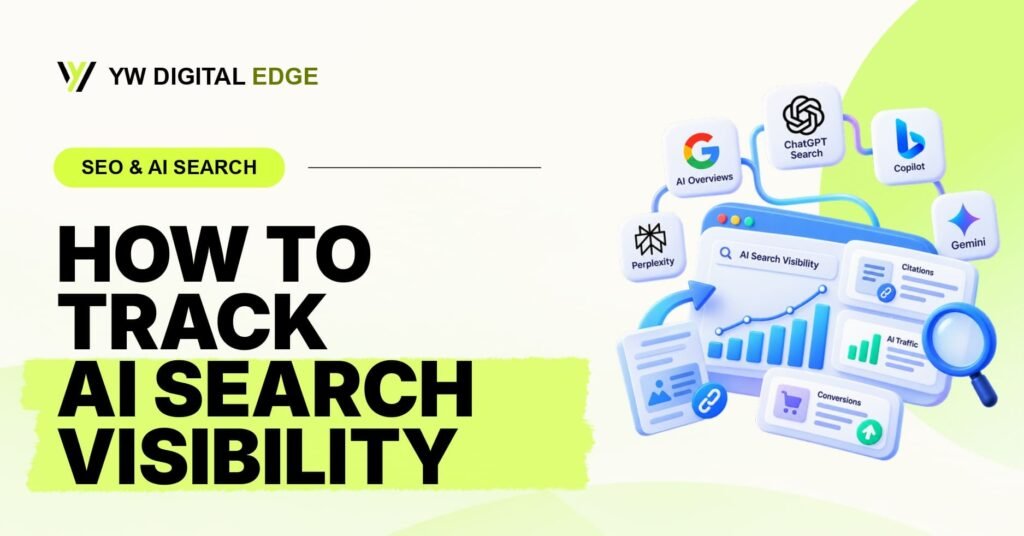
Your website appears in an AI-generated answer. Now what do you measure?
A citation does not necessarily produce a click. A brand mention may create visibility without sending a visitor to your website. Even when an AI platform does send traffic, the visit means little commercially unless you know what happened next.
AI search visibility therefore needs to be measured at several levels:
Visibility → Citations → Traffic → Business outcomes
The tools for doing this have improved significantly in 2026. Google Search Console now provides dedicated reporting for generative AI visibility, while Bing Webmaster Tools can show citations, cited pages, grounding queries and broader citation patterns. Analytics can then help connect some of that visibility with visits and conversions.
The useful question is not simply, “Are we appearing in AI search?”
It is:
Where are we appearing, what content is earning that visibility, and does it matter to the business?
Start With the Signals You Can Actually Measure
AI search visibility is not one metric.
A website can be visible in several ways, and each leaves a different trail of data.
| Signal | What It Can Tell You |
|---|---|
| AI impressions | Whether your pages are appearing in supported AI search experiences |
| Citations | Whether your content is being shown as a source |
| Cited pages | Which URLs are contributing to AI answers |
| Topics and grounding queries | What subjects are associated with that visibility |
| Citation share | How your citation presence compares within a query |
| AI referrals | Whether users continue from an AI experience to your website |
| Conversions | Whether those visits lead to useful business outcomes |
You do not need every metric from the beginning.
Start with the signals available through first-party tools, then add analytics and manual research where they answer a specific question.
Check Your Generative AI Visibility in Google Search Console
Google introduced dedicated Generative AI performance reports in Search Console in June 2026 and completed the worldwide rollout in August.
The Search report shows impressions from generative AI features such as AI Overviews and AI Mode. It can also show which pages appeared, where the impressions came from, the devices involved and changes over time.
The first thing to review is not the total impression number.
Look at the pages.
Suppose a furniture retailer finds that four pages are receiving substantial generative AI impressions:
- Dining Table Size Guide
- Round vs Rectangular Dining Tables
- Small Dining Tables category page
- How to Choose Furniture for a Small Apartment
There is already something useful in that pattern.
The site appears to be gaining visibility around small-space furniture and dining-table decisions.
That gives the business something more actionable than simply knowing it received 20,000 AI impressions.
It can investigate why those pages are being surfaced, whether related pages show similar patterns and whether the visibility connects with commercially important topics.
Do Not Treat an AI Impression as a Visit
An impression tells you that a URL appeared within Google’s generative AI features.
It does not tell you that someone visited the website.
This distinction becomes important when interpreting performance.
Imagine this monthly comparison:
| Metric | August | September |
|---|---|---|
| Generative AI impressions | 9,000 | 14,000 |
| Organic visits | 3,200 | 3,100 |
| Enquiries | 82 | 85 |
AI visibility increased considerably, while visits remained relatively stable.
That does not automatically mean the additional visibility had no value. Users may have encountered the business or its information within the search experience without clicking.
It also does not prove that AI visibility caused anything else.
Treat the impression as one signal and look for supporting evidence elsewhere.
Use Bing Webmaster Tools to See Citations
Bing Webmaster Tools answers a different measurement question.
Its AI Performance report shows how content from your website is cited across supported AI experiences, including Microsoft Copilot, AI-generated summaries in Bing and selected partner integrations.
Microsoft’s AI Performance documentation includes metrics such as:
- Total citations
- Average cited pages
- Grounding queries
- Page-level citation activity
- Citation trends over time
This is useful because a citation is different from an impression.
If a page is repeatedly cited, you know that its content is being visibly referenced as a source within the AI experiences covered by the report.
But keep the metric within its limits.
Microsoft explicitly notes that citation activity does not indicate ranking, authority, importance or the role a page played within an individual answer.
A citation means the page was cited.
Do not turn it into a broader quality score.
Find Out Which Pages Are Earning Citations
Domain-wide citation totals can hide the most useful information.
Open the page-level data.
Imagine an online skincare retailer has published these resources:
- How to Choose Sunscreen
- Mineral vs Chemical Sunscreen
- SPF Guide
- Skincare Routine for Oily Skin
- Sunscreen Product Category
The Mineral vs Chemical Sunscreen guide receives considerably more citations than the others.
That gives the content team a useful page to study.
Does it provide a clearer comparison? Does it answer more specific questions? Is the information better supported? Does it contain a useful table? Has it been updated more recently?
You cannot conclude that one of these elements caused the citation activity.
You can identify patterns worth investigating.
Do the same across several cited pages. Over time, you may find that certain subjects, formats or levels of detail repeatedly earn more source visibility.
Look at the Topics Behind the Citations
Individual citation counts become more useful when you understand the subject behind them.
Bing’s AI Performance reporting includes grounding queries: grouped phrases associated with content that was cited in AI-generated answers. Microsoft notes that these are aggregated phrases, not a record of individual user prompts.
For example, a furniture website might see activity associated with phrases such as:
- small dining table
- dining table size
- dining table for apartment
- round dining table
- dining table for four people
Looking at each phrase individually is useful.
Seeing the common subject is better.
The website appears to have visibility around:
Dining tables for smaller spaces
That gives the business a topic it can evaluate across multiple pages.
Does it already have strong coverage? Are product pages supporting the guides? Are there obvious customer questions that remain unanswered?
AI visibility becomes much easier to act on when it is connected to a recognisable subject.
Add Intent to the Picture
Two websites can receive the same number of citations and have very different commercial opportunities.
Consider these questions:
Group A
- What is veneer?
- What is solid wood?
- What is a console table?
Group B
- Best dining table for a small apartment
- Round or rectangular table for four people
- Where to buy a compact dining table
- What size table fits a 3-metre dining area?
Both groups can create useful visibility.
The second group is closer to product evaluation and purchase.
This is why citation volume should be read alongside intent.
Microsoft added Intents and Topics to Bing Webmaster Tools in 2026, providing additional context around the citation activity associated with a website. Its intent classifications can include informational, commercial, navigational, research and local needs, among others.
For business reporting, a useful sequence is:
Topic → Intent → Citation → Page → Outcome
That prevents the citation count from becoming an isolated vanity metric.
Use Citation Share for Competitive Context
Suppose your website received 150 citations during the month.
Is that strong?
The number alone cannot tell you.
Citation Share provides additional context by showing the percentage of citations attributed to your site out of the citations shown across sites for the same grounding query.
Microsoft is careful about how this metric should be interpreted. Citation Share is intended as an observational measure, not a ranking system or competitive score.
Use it directionally.
A home improvement website might discover:
| Topic | Observation |
|---|---|
| Kitchen cabinet materials | Strong citation presence |
| Small kitchen layouts | Growing visibility |
| Kitchen renovation costs | Limited presence |
| Countertop comparisons | Lower citation share |
Now the data can support a content decision.
The business may decide that its renovation-cost content needs more useful detail, or that countertop comparisons deserve stronger coverage.
The goal is not to win every citation.
It is to understand where your website has meaningful visibility and where important gaps remain.
Track AI Referral Traffic Separately Where Possible
Some AI interactions end inside the answer.
Others lead to your website.
Analytics can help you study the second group when referral information is available.
Look for visits associated with AI assistants and search experiences, then review:
- Sessions
- Landing pages
- Engagement
- Enquiries
- Purchases
- Revenue where applicable
Landing pages deserve particular attention.
Suppose an ecommerce store receives most of its AI referrals through buying guides, while traditional organic traffic enters mainly through category and product pages.
That suggests the channels are supporting different stages of discovery.
Review what visitors do after entering through those guides.
Do they open product pages?
Do they compare several items?
Do they add products to their cart?
Do they purchase?
The referral itself is only the beginning of the useful analysis.
Compare Traffic With Business Outcomes
A small traffic source can still be valuable.
Consider this example:
| Channel | Sessions | Conversions | Conversion Rate |
|---|---|---|---|
| Organic Search | 5,000 | 150 | 3.0% |
| Paid Search | 2,000 | 90 | 4.5% |
| AI Referrals | 300 | 18 | 6.0% |
AI referrals represent only 300 sessions.
If you looked only at traffic volume, the channel might appear unimportant.
The conversion data changes the interpretation.
It still would not be sensible to declare AI referrals the “best” channel from this table alone. The sample is smaller, acquisition paths differ and conversion rates can fluctuate.
But it gives you a reason to keep watching.
For a service business, the same analysis could use qualified enquiries, calls, bookings or quote requests instead of ecommerce purchases.
Include Image-Led Search Where It Matters
AI search visibility is not limited to text-based questions.
For businesses with visually important products or services, customers may begin with an image.
Google introduced web multimodal search reporting in Search Console in September 2026. The reporting covers image-based search journeys across experiences such as Google Lens, Circle to Search, image uploads to Google Search and Chrome’s Search this image feature.
This is particularly relevant to:
- Furniture
- Fashion
- Home décor
- Beauty
- Accessories
- Interior design
- Visually distinctive ecommerce products
Review which pages receive multimodal impressions and clicks, then examine the visual assets on those pages.
Are products easy to identify?
Do the photographs show useful details?
Does the surrounding page explain dimensions, materials, colours and variations?
These questions connect measurement back to multimodal SEO and visual search.
The report tells you where visual discovery is happening. The page itself can help explain what users find when they arrive.
Keep Manual Testing, but Give It the Right Job
Opening ChatGPT, Copilot or another AI search experience and testing customer questions can still be useful.
It can show you things that a dashboard may not explain clearly:
- Which brands are mentioned
- Which sources appear together
- How competitors are described
- What information is included in an answer
- Whether your products or services are represented accurately
- What kinds of pages tend to be cited
Use a group of related questions rather than repeatedly checking one prompt.
A local renovation company might test questions around:
- kitchen renovation company
- renovation cost for small apartment
- contractor for condo renovation
- kitchen cabinet material comparison
- questions to ask before hiring a renovation contractor
Look for patterns.
If the same competitors repeatedly appear across commercially important questions, study the sources and information behind that visibility.
Manual testing works well as qualitative research.
It is much weaker as a precise ranking tracker because generative answers can vary.
Do Not Let a Visibility Score Become the Goal
Third-party SEO platforms increasingly offer AI visibility scores, prompt tracking, citation monitoring and brand mention reports.
These tools can be useful.
The number they produce still needs interpretation.
Different platforms may monitor different prompts, models, locations and AI systems. They may also calculate visibility in different ways.
A score moving from 42 to 48 is only useful if you understand what changed underneath it.
Did more commercially relevant prompts include the brand?
Did an important page begin receiving citations?
Did visibility improve across an important topic?
Did referral traffic or conversions change?
Use the score as a signal that tells you where to investigate.
Do not optimize the business for the score itself.
Build a Small Dashboard Before a Complicated One
A useful monthly report does not need 40 AI metrics.
Start with a manageable set:
| Area | What to Review |
|---|---|
| Google AI visibility | Generative AI impressions and visible pages |
| Citations | Total citations and cited URLs |
| Topics | Subjects associated with citation activity |
| Intent | Commercial, informational, local and other relevant needs |
| Competitive context | Citation Share where useful |
| AI referrals | Sessions and landing pages |
| Business results | Enquiries, sales, bookings or revenue |
Then add detail when it helps you make a decision.
For example, if citation activity suddenly increases, investigate the pages and topics responsible.
If AI referral traffic grows, examine landing pages and conversions.
If multimodal impressions increase for a product category, review the images and product information.
Reporting should lead somewhere.
A Monthly Review Can Be Simple
Once the tracking is in place, five questions are enough to begin a useful review.
Where did we gain or lose visibility?
Look at meaningful changes across Google AI impressions, Bing citations and AI referral traffic.
Which pages contributed to the change?
Identify the URLs that gained visibility rather than treating the domain as one unit.
What topics and customer needs were involved?
Separate strategically useful discovery from broad exposure.
Did any of that visibility lead to business activity?
Review visits, enquiries, sales and other relevant outcomes.
What should we improve next?
Choose something specific.
It might be updating an outdated guide, adding missing product information, improving original photography or expanding a subject where the business is already beginning to earn visibility.
The value of AI search reporting comes from this final step.
Measure Progress, Not Presence
There is no universal number of AI impressions or citations that defines good performance.
A local service business and an international ecommerce store should not expect the same visibility pattern.
What matters is whether the website is becoming easier to discover for the questions that matter to its customers.
That might mean more pages appearing across an important topic. It might mean stronger citation presence for commercial questions. It could also mean a small but growing stream of AI referrals that consistently produces qualified enquiries.
Start with the first-party data you can trust. Add analytics to understand what happens after the visit. Use manual testing and third-party tools to fill specific gaps.
Then watch how the picture develops over time.
AI search visibility becomes useful when you can connect where the business appears with why that visibility matters.